Increased adoption by 15% by simplifying complex repair request workflows
Redesigned legacy repair portal serving 40,000+ accounts
PROJECT AT A GLANCE Role: Lead Product Designer (End-to-End) Timeline: 6 months (Q1-Q2) Team: 1 Product Manager, 1 Tech Lead, 4 Frontend/Backend Engineers, 1 QA Lead Core Metric: Reduced support calls by 25% Improved engagement by 15%
Client
Infusion Repair Center
Industries
Healthcare
Services
Product Design (End-to-End) (Includes: UI & UX Design, UX Research, UX Design Product Management, Front-End Code)
Date
April 2025

THE BUSINESS PROBLEM & CONSTRAINTS BioMeds were abandoning the legacy tool because of a convoluted 5-step form, leading to a 94% drop-off rate and thousands in delayed maintenance costs.
THE GOAL Design an intuitive, accessible, and guided repair and recall request experience that reduces incomplete submissions and support escalations, while strengthening trust between customers and its digital platform.
THE OPPORTUNITIES Guided by user research, the project aimed to unify and modernize the portal experience through streamlined workflows and brand alignment, while empowering internal teams with data accuracy, compliance, and robust reporting for better decision-making.
Key Responsibilities & Ownership:
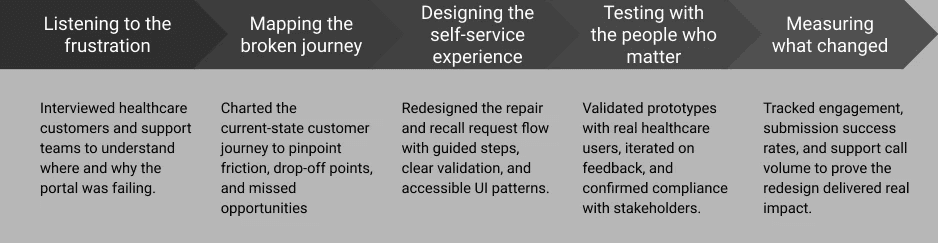
As the sole product designer on this initiative, I owned the end-to-end product lifecycle: from exploratory user research and workflow architecture to high-fidelity UI design and validation with field technicians. I also handled: Stakeholder & Tech Alignment: Partnered closely with engineering early in the discovery phase to audit the legacy system, mapping out technical constraints, database limitations, and API latency boundaries before touching Figma. Navigating Legacy Constraints: When engineering flagged that a complete backend rebuild was unnecessary, I pushed back on a simple "reskin" and instead redesigned the front-end orchestration layer, hiding complex database queries behind a streamlined, 2-step progressive disclosure flow. This push back was backed by data from my user research and surveys. Cross-Functional Governance: Led weekly design syncs with PM and engineering leads to prototype edge cases, stress-test data models for offline field use, and ensure design handoff included comprehensive states (loading, error, empty, and offline sync). To achieve this, I followed a user-centered, iterative design process, starting with research and problem definition, then moving through ideation, design, and validation. By collaborating closely with stakeholders and engineering, I ensure solutions are intuitive, scalable, and aligned with business goals.

Final Design

OUTCOME Cost Reduction (Manual Error): Reduced the time and resources needed to audit and correct manual transactions, leading to an annual cost reduction of $700K per year. Operational Efficiency: Achieved increased efficiency through a simplified, guided workflow with built-in guardrails, directly reducing internal processing costs by $45K annually. Customer Self-Service & Adoption: Increased overall portal adoption by 15% by offering modernized self-service options, resulting in a 30% reduction in customer service call volume. Cost Reduction (Process Automation): Saved the company $1.15 million annually by automating the process for configuring and managing field projects, significantly reducing required time and effort. Final output: Redesigned legacy repair portal - Migrated an outdated SAP-based system serving 40,000+ accounts (57% of service requests) to Salesforce, replacing complex onboarding and inconsistent branding with a unified, scalable customer experience and robust internal reporting.


